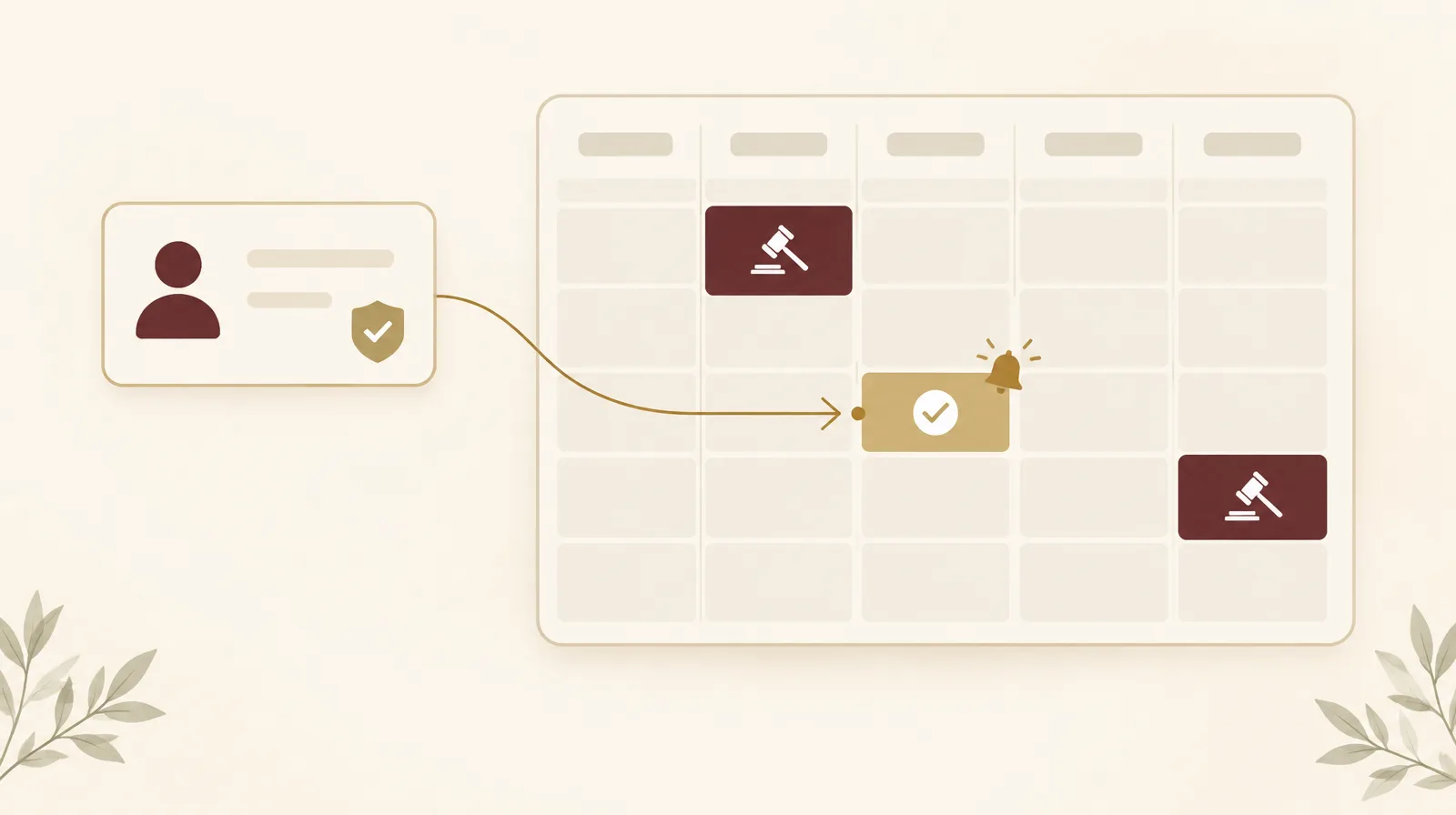
Hearing Dates in Najiz: How a Firm Logs Every Hearing on Time
A lawyer learns a hearing date from Najiz or an electronic notice. How a firm logs the hearing and reminds the team and client in time.

At nine in the evening a text message reaches the lawyer's phone, setting a hearing in a labor case for 12 November. He reads it on the way home and plans to log it in the firm's calendar in the morning. The morning fills up, so he writes it on a sticky note and plans to add it to his email calendar later. If he forgets, or the note goes missing, nobody at the firm will know there is a hearing.
The problem here is not learning the date. The court sends notice of it, and Najiz shows it. The problem is the gap between the moment the lawyer learns the date and the moment it enters a record the whole team can see.
Where the hearing date comes from
The Ministry of Justice offers lawyers a service in Najiz for viewing hearing dates. The lawyer logs in with Nafath, and the service needs a valid power of attorney that includes a pleading clause, and a case under consideration with a scheduled hearing. The service is available through the Najiz app, the Tawakkalna app, the Najiz platform, or Najiz centers.
This has two practical effects. First, the lawyer can check the date at its source at any time. Second, the power of attorney is a condition for viewing it, so if it expires without renewal, this route is no longer open to him.
An electronic notice is not a passing message
Besides Najiz, court notices arrive by text message to a verified mobile number, by verified email, or through an account on a government system. According to what the judicial authorities have announced, notice by these means has carried legal effect since 2018.
So a firm should not treat such a message as a passing alert, since it may be the notice itself. The firm needs a clear rule here: every notice that reaches any lawyer is logged in the case file on the day it arrives. The details of a notice's legal effect are a legal matter to be checked against the official texts, and this article offers no legal opinion on them.
Log the date as it arrives
Courts and Najiz show hearing dates in the Gregorian calendar, the same one the firm's email and meeting calendars use. So the lawyer logs the date in Jlsa exactly as it appears in the notice, and any colleague can check it against the notice in seconds.
A Hijri date still turns up in older documents, such as a deed or a power of attorney issued years ago. In that case the user adds the Hijri date next to the Gregorian date, as written in the document.
A firm should write its internal rule down. Who logs the hearing? Within how many hours of the notice arriving? Who checks the date? A short rule like this prevents most of the errors that come from late logging.
Reminders days before the hearing
A reminder on the day of the hearing is too late. The lawyer needs time to read the file, review the last memo, and coordinate with the client. So the firm sets the reminder lead time in days before the hearing, and it is one day if left unchanged. The reminder reaches the case team by email, so the date does not sit in one lawyer's memory. The team also gets a weekly activity email.
The firm picks the lead time that suits most of its cases. A hearing that needs a written memo needs more preparation time than others.
Each hearing also records which team members will attend, and its place or its link if it is remote. If a colleague is absent, the stand-in lawyer knows where to go or which link to open, without searching through the colleague's messages.
The client and the hearing date
Many clients ask about their hearings by phone, and the answer is sometimes late because the lawyer is in another hearing. The system sends the hearing notice to the client by email or SMS, so the client knows the date without calling.
When the firm proposes a date for a hearing and needs the client's agreement, the system sends the client a secure link to accept or reject it. The reply is recorded in the case file, so the agreement does not stay in a phone call that leaves no trace.
After the hearing: what happened and what comes next
Many hearings end with a new date, a request for a document, or a judgment. That information is lost if it waits until the lawyer is free. So after the hearing the system asks the attending lawyer to fill in a notes form, and reminds him if he does not. He writes what took place, and the next hearing is added to the file with its date.
If a judgment is issued, its date and the last day to object to it are recorded in two fixed fields in the case file. Calculating that deadline is the lawyer's responsibility under the applicable rules, but recording it in a field the team can see keeps it from living in one person's head.
When a hearing date changes
Dates do not always hold. A hearing is postponed, its time changes, or it moves online. In each case there is a risk that part of the team keeps working to the old date.
So the date is updated in the case file as soon as it is known. The hearing link is added if it becomes remote. The system keeps the history of edits to the hearing, so the team knows the previous date, who changed it, and when. The lawyer in charge should also confirm the new date in Najiz, because the firm's file is entered by hand and the reference is what Najiz shows.
The power of attorney as a condition for viewing
As noted above, the Najiz service for viewing hearings depends on a valid power of attorney. The system keeps a register of powers of attorney with each one's expiry date, and sends a daily reminder of those nearing expiry. Each case is linked to its power of attorney, so whoever opens the file knows whether it is still valid.
A short review for your firm
Ask your team two questions. When was the last notice that reached one of them logged in the case file? And who besides the assigned lawyer knows the next hearing date? If the answer is unclear, the date lives in someone's memory, not in the firm's record.
The article on the case file in a law firm covers the rest of what a file holds from filing to judgment.